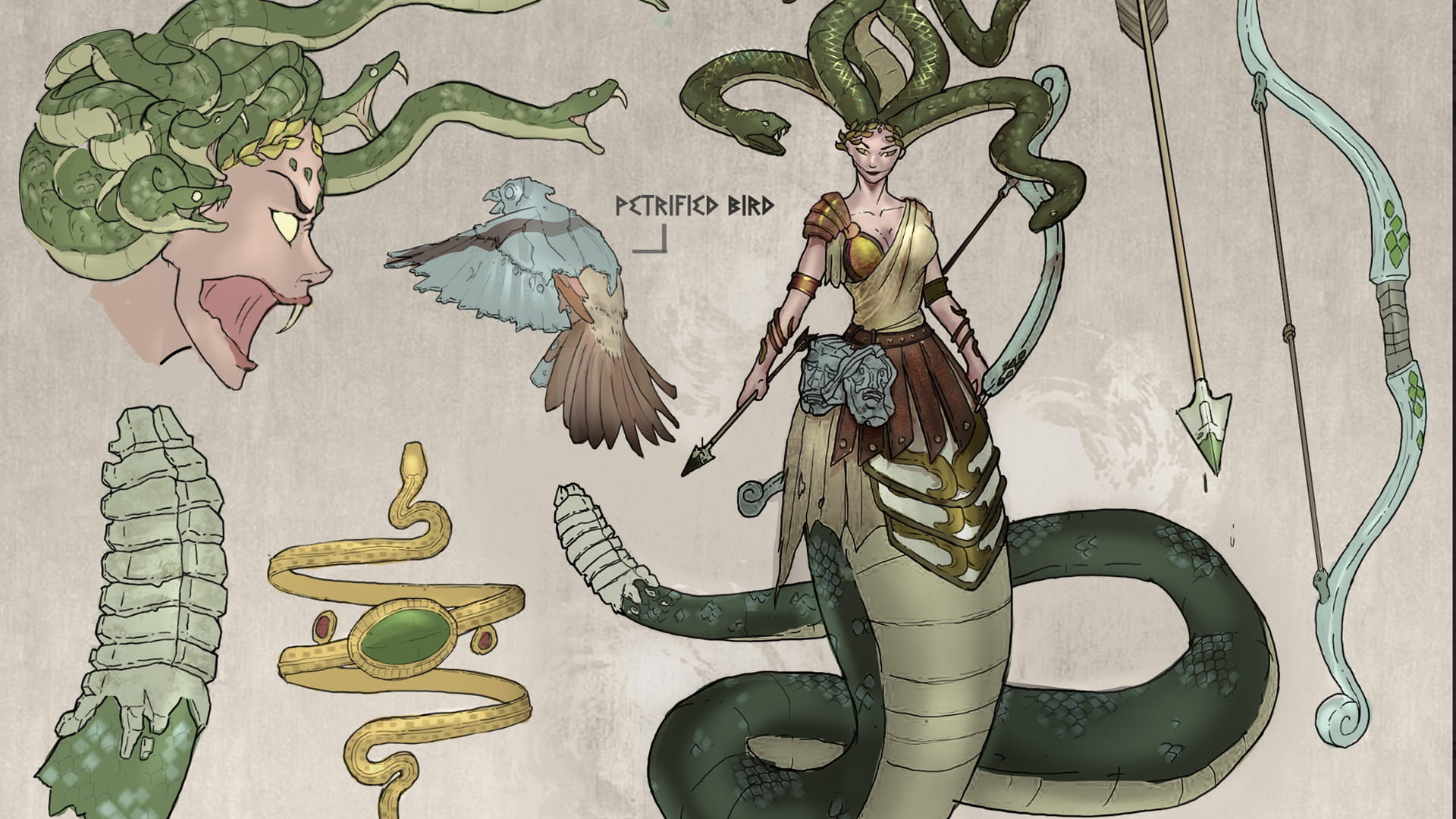
The Psychology of Design: What Makes Characters Memorable
9 February, 2026
Learn how Concept Artists use character silhouette psychology, emotional character design, and visual identity to create characters audiences remember. Explore the psychology behind character appeal.
Some characters stay with you for years. Others disappear the moment the screen fades to black. This difference is rarely accidental. It is designed.
Long before dialogue, animation, or performance comes into play, the human brain makes a judgment about a character.
That judgement is visual, instinctive, and fast. This is where the Concept Artist steps in. Not as a decorator, but as a behavioural designer.
To understand why certain characters endure, we need to understand how people see, recognise, and emotionally respond to visual forms.
Why Our Brains Remember Visuals First
Humans are wired to remember images far more easily than words. Long before modern entertainment existed, survival depended on recognising shapes quickly. Friend or threat. Familiar or unknown.
Psychology backs this up. Studies on visual memory show that people can recognise thousands of images with surprisingly high accuracy even after brief exposure.
In one well-known study, participants were able to recognise previously seen images with accuracy rates exceeding 80 per cent, even when the number of images crossed into the thousands
(Source: National Library of Medicine).
For a Concept Artist, this explains something crucial.
If a character does not register clearly at a glance, it struggles to exist in memory at all.
Concept Artist: The Creative Mind Behind Visual Worlds
Read this blog to understand what a Concept Artist actually does and why their decisions shape everything you experience visually.
Character Silhouette, Psychology, and Instant Recognition
The silhouette is the first psychological checkpoint in character design. Before colour, texture, or detail, the brain registers shape.
Research into object recognition has shown that humans can identify objects accurately even when detail is removed, as long as the outline remains distinctive
(Source: Research Gate).
This is why experienced Concept Artists obsess over silhouettes early in the process.
Think about this practically.
If you reduce a character to a black shape and it still feels recognisable, the design has strength. If it collapses into a generic form, no amount of rendering will save it.
This is also why iconic characters work across media. A strong silhouette survives animation, toys, posters, and even poor lighting. A weak one does not.
Emotional Character Design Starts with Shape, Not Detail
Once recognition is achieved, emotion follows. Shape language plays a quiet but powerful role here.
Broadly speaking:
- Rounded forms feel safe, friendly, and approachable
- Sharp angles feel aggressive, dangerous, or unstable
- Heavy, square shapes feel grounded and immovable
This is not theory for theory’s sake. It is how people intuitively read forms in daily life. Concept Artists deliberately use this psychological bias.
A gentle companion character built entirely from sharp triangles would feel wrong, even before the story explains who they are.
Conversely, a villain designed with soft, childlike proportions creates dissonance unless that contrast is intentional.
Good emotional character design aligns visual form with behavioural expectation.
How World-Building Works: Concept Artists & Narrative Design
If a world feels believable, it was designed that way long before the story unfolded.
Read this blog to see how Concept Artists and narrative design come together to build worlds that feel lived-in.
Character Visual Identity is a System, not a Costume
A common mistake among beginners is treating character design as surface styling. Memorable characters are not memorable solely because of their accessories or costumes. They are memorable because their visual identity is consistent.
Visual psychology refers to this as pattern reinforcement. When the brain sees repeated, coherent cues, recognition strengthens.
This includes:
- Consistent shape language
- A limited, intentional colour palette
- Repeating motifs or proportions
The “picture superiority effect” explains why this works. People recall images more reliably than text because visuals create stronger memory traces
(Source: Wikipedia).
For a Concept Artist, this means restraint matters more than excess. Too many ideas weaken recall. Fewer, stronger signals build identity.
Why do Some Characters Feel Emotionally Hollow
You can often sense when a character looks impressive but feels empty. This usually happens when visual decisions are made without psychological grounding.
Common causes include:
- Overdesigned details that break silhouette clarity
- Conflicting shape language that confuses personality
- Visual choices driven by aesthetics rather than intent
From a cognitive perspective, this creates noise. The brain fails to form a clear mental category for the character. When that happens, recall drops sharply.
This is why some technically skilled designs are forgotten while simpler characters persist for decades.
From Idea to Production: The Concept Art Pipeline Explained
Most ideas do not fail creatively. They fail in the pipeline.
Read this blog to understand how concept art moves from early sketches to production without losing intent.
How Concept Artists design for memory, not attention
Attention is temporary. Memory is selective.
A Concept Artist designs with this difference in mind. The goal is not to impress in a single frame, but to remain recognisable across time and context.
This means asking uncomfortable questions early:
- Would this character still work without colour?
- Does the form communicate personality without explanation?
- Is the design readable from a distance
Characters that pass these tests tend to survive production changes, animation styles, and even audience ageing.
Conclusion
Memorable characters are not accidents. They are the result of visual psychology applied with discipline. From silhouette clarity to emotional shape language and consistent visual identity, the Concept Artist plays a behavioural role as much as an artistic one.
When character design aligns with how humans actually see and remember, characters stop being images and start becoming presences.
For art enthusiasts and aspiring Concept Artists alike, understanding this psychology is the difference between designs that look good and designs that last.
At MAGES Institute, character design is taught from a Concept Artist’s perspective, where behaviour, emotion, and visual identity come before polish.
If you want to design characters that connect instantly and stay memorable, learn the thinking behind the form.
Explore Concept Art and Visual Development programmes at MAGES
FAQs
1. What makes a character memorable in design?
A character becomes memorable when its silhouette, shape, language, and visual identity clearly communicate its personality. Strong character design aligns visual cues with how people recognise and remember forms.
2. Why is silhouette important in character design?
Silhouette is important because the human brain recognises shape before detail. Character silhouette psychology helps Concept Artists ensure instant recognition even without colour or texture.
3. How does a Concept Artist use psychology in character design?
A Concept Artist applies visual psychology by using shape language, proportion, and visual consistency to trigger emotional responses and reinforce character appeal.
4. What is emotional character design?
Emotional character design focuses on how a character makes the audience feel at first glance. It uses visual cues such as curves, angles, and posture to suggest personality and behaviour.
5. What is character visual identity?
Character visual identity is the complete visual system of a character, including silhouette, shapes, colours, and recurring design elements. Consistency in this system improves recognition and memory.
6. Why do some well-drawn characters feel forgettable?
Characters often feel forgettable when they lack a strong silhouette, clear visual hierarchy, or emotional intent. Excessive detail without visual clarity weakens character appeal.
7. Is character appeal more important than realism?
Yes, in most storytelling mediums, character appeal matters more than realism. Concept Artists prioritise readability and emotional connection over anatomical accuracy alone.
8. Why should art enthusiasts study character psychology?
Studying character psychology helps art enthusiasts understand why certain designs endure. It trains designers to think beyond aesthetics and focus on how audiences perceive and remember characters.
Related Posts
SPEAK TO AN ADVISOR
Need guidance or course recommendations? Let us help!