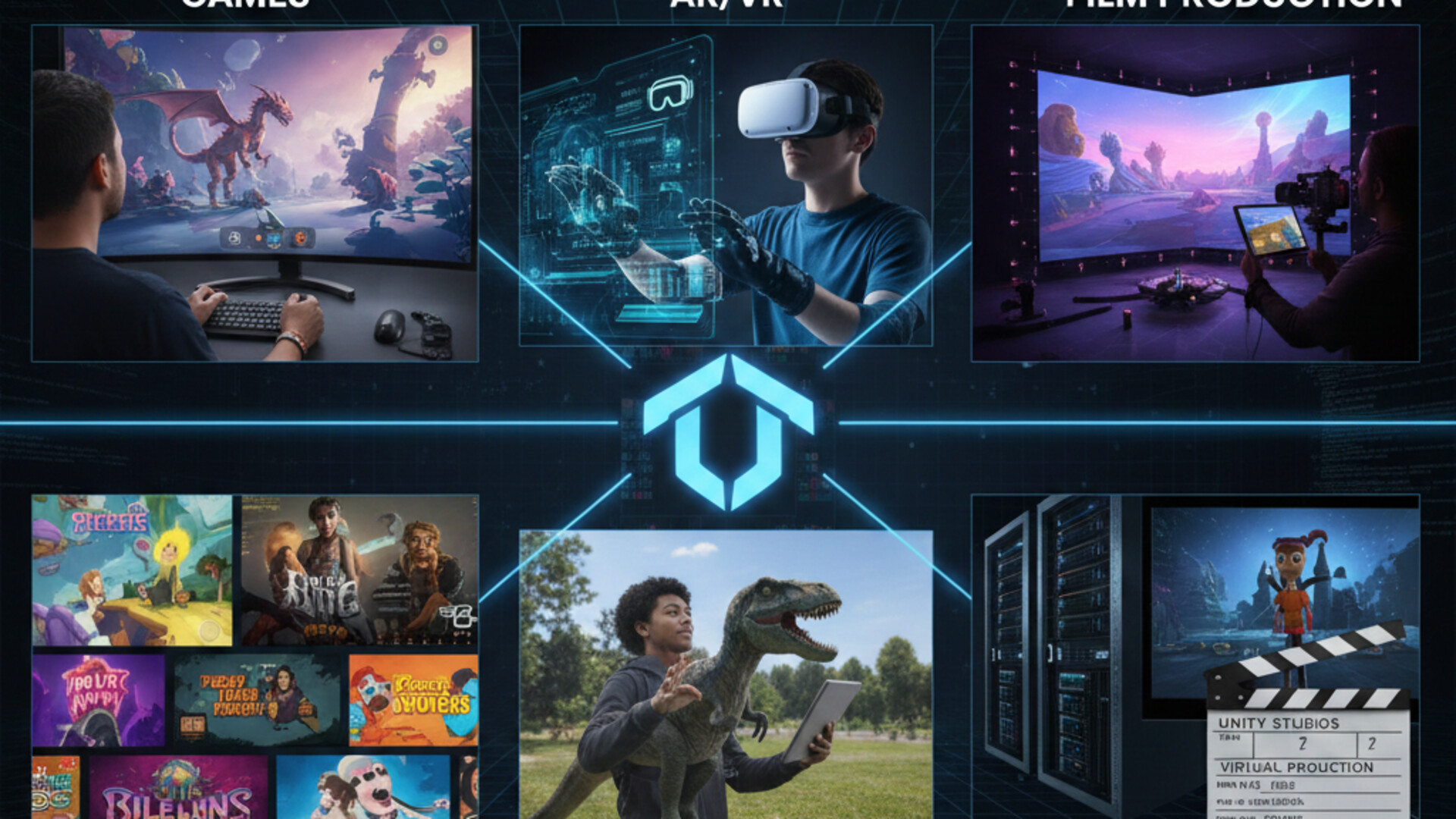
How Unity is Used in Games, AR/VR & Film Production
23 January, 2026
Explore how Unity is used across gaming, AR/VR, and film production. Learn Unity 3D with real examples and discover how this real-time engine powers interactive experiences.
When people decide to Learn Unity 3D, most of them think only about making games. That is the easiest mental leap.
But Unity has quietly become a real-time engine used across several major industries, each with distinct opportunities, workflows, and career paths.
This blog explores real case studies of how Unity is used in gaming, AR/VR, and film production – not as a list of features, but as lived realities where Unity skills actually matter.
Understanding Unity’s role across industries helps beginners see beyond tutorials and understand why investing in this tool makes sense in 2026 and beyond.
Unity in the Gaming Industry: The Core Use Case
Unity started as a game engine, and games remain its largest and most visible domain. But it isn’t just about indie games or mobile titles anymore; it powers multiple layers of interactive experiences.
According to Statista, the global video game market was valued at nearly USD 299 billion in 2024 and is projected to reach upwards of USD 600 billion by 2030, driven by expansion across platforms and audiences.
(Source: Grand View Research).
Within this massive ecosystem, Unity plays a significant role:
- Mobile games: Unity is widely used by small teams and solo developers because it is flexible, lightweight, and optimised for mobile platforms.
- Indie titles: Successful indie games like Hollow Knight and Cuphead use Unity to handle 2D/3D environments with tight controls and expressive visuals.
- Live service games: Features such as real-time updates, multiplayer systems, and scalable content delivery are built with Unity backends or client logic, even in mid-scale titles.
Example: A small indie team might prototype a 2D platformer in Unity over several weekends, iterating on collision, physics, and animation until the core gameplay feels tight.
Because Unity’s animation tools and real-time feedback loop are fast, they can make adjustments on the fly without extensive recompilation.
This real-world usage shows that Unity is not just a starter engine; it is a production engine, used professionally by diverse developers.
Unity in AR/VR: Immersive and Interactive Realities
Unity’s expansion beyond traditional games is most visible in the AR (Augmented Reality) and VR (Virtual Reality) spaces.
Real-time engines like Unity are uniquely suited to immersive experiences because they handle interaction, physics, and rendering in ways that static engines or pre-recorded media do not.
The AR/VR market has been growing rapidly. Projections suggest the VR gaming market alone could surpass USD 100 billion by 2030, reflecting demand in entertainment, enterprise training, education, and simulation.
(Source: Grand View Research)
How Unity fits into AR/VR:
- Enterprise training uses Unity to build VR scenarios for industries like healthcare and manufacturing. These simulations require accurate collision detection, dynamic feedback, and smooth performance – all areas where Unity’s real-time systems excel.
- Consumer VR experiences such as puzzle games, exploration titles, or fitness avatars are built in Unity to leverage cross-platform support from mobile VR headsets to tethered VR.
- AR mobile experiences use Unity to place interactive content in the real environment, blending 3D objects with real-world camera input.
Example: A hospital uses a Unity-based VR simulation to train nurses on emergency procedures.
Instead of reading steps in a manual, trainees practice in a controlled environment where mistakes have no real consequences.
Unity’s physics and interaction systems allow the simulation to feel natural and responsive.
This demonstrates Unity’s value in domains where interaction with simulated reality is not optional, but essential.
Not all Unity courses are built for beginners, and understanding which ones actually help you finish projects can save months of frustration. Read here:
Best Unity 3D Courses for Beginners in 2026
Unity in Film Production: Real-Time Visual Storytelling
Film production was once solely the domain of offline rendering and expensive render farms. Unity, along with other real-time engines, has changed that.
Today, Unity is used in real-time visualisation, virtual sets, and previsualisation – speeding up production pipelines and lowering costs.
Example: A film director can block scenes in real time, adjust lighting interactively, and preview camera moves instantly rather than waiting hours for renders.
This approach mirrors video game development, but with film-specific requirements like high-fidelity lighting and cinematic framing.
Unity’s animation tools, timeline features, and integration with motion capture systems allow film teams to visualise complex scenes rapidly.
Rather than waiting for final CG renders, teams can iterate in real time – a massive advantage for creative decision-making.
Because Unity supports real-time feedback loops, artists and directors can experiment with lighting, shot composition, and motion capture data interactively.
This shifts some of the traditional post-production load upstream, leading to faster creativity cycles.
Case Study Snapshot: From Learning to Production
To understand how skills transfer across these industries, it helps to look at a simple pattern.
A beginner learning Unity does things like:
- Scene and object setup
- Basic scripting for movement and interaction
- Animations tied to player input
- UI feedback systems
These skills translate directly into:
- Game logic and gameplay programming
- AR/VR interaction and environmental reaction
- Real-time visualisation for interactive simulations or film scenes
The same concepts of collision detection, animation timing, real-time interaction – are reused with different end goals. In AR/VR, collision logic might trigger environmental feedback. In film, animation timing might influence camera choreography.
In games, both might determine how a player experiences challenge and reward.
This is why the skills outlined in the
Unity 3D Roadmap for Beginners (Step-by-Step Guide 2026)
Do not just prepare you for games. They prepare you for interactive systems across disciplines.
Unity skills open doors far beyond games, and understanding how those skills translate into real roles helps you plan learning with purpose. Read here: Careers in Unity 3D: Roles, Skills & Salary Guide
What This Means for Your Career
When you choose to Learn Unity 3D, you are not just picking a tool.
You are learning a way to build interactive logic that runs in real time – and that is valuable in multiple creative and technical fields.
According to industry reports, the demand for real-time developers continues to expand beyond games into simulation, XR design, and interactive storytelling.
As studios, enterprise teams, and creative groups adopt real-time workflows, Unity skills are increasingly transferable.
This aligns with the patterns described in
Careers in Unity 3D: Roles, Skills & Salary Guide
where entry-level development roles are not limited to traditional game companies but extend into immersive and visual production industries.
Final Takeaways
Unity started as a game engine. That is where most people begin their journey.
But by 2026, Unity is more than that. It is a real-time development engine used in games, AR/VR, and even film production.
For beginners, this breadth is not confusing. It is empowering. Because when you Learn Unity 3D, you are not learning a niche tool.
You are learning a foundation for interactive storytelling, immersive experiences, and real-time digital production across multiple industries.
If you want a learning path that reflects how Unity is actually used professionally – across gaming, AR/VR, and real-time media , MAGES Institute offers structured Unity training that goes beyond tutorials.
MAGES programs teach Unity as a development mindset: progression, real project execution, system thinking, and real-world workflows.
If your goal is to build interactive systems that work in games, simulations, or virtual experiences, MAGES Institute gives you the direction and practice you need.
FAQs
1. Is Unity mainly used for games, or is it relevant beyond gaming?
Unity began as a game engine, but today it is widely used in AR, VR, simulations, training systems, and real-time film production. Its real-time rendering and interaction capabilities make it valuable across multiple industries.
2. Why do so many developers choose Unity in the gaming industry?
Unity offers fast iteration, cross-platform support, and a flexible workflow. It allows teams to prototype, test, and ship games efficiently, especially for mobile, indie, and mid-scale projects.
3. How is Unity used differently in AR and VR compared to games?
In AR and VR, Unity focuses more on spatial interaction, performance stability, and real-world alignment. The core systems are the same, but the emphasis shifts toward immersion, responsiveness, and user comfort.
4. Is Unity actually used in film production, or is that overstated?
Unity is actively used in previsualisation, virtual sets, and real-time visualisation in film and media production. It allows directors and artists to experiment with lighting, camera movement, and animation in real time.
5. Do Unity animation tools work for non-game projects?
Yes. Unity animation tools are used for character movement in games, interactive VR simulations, and motion previews in film production. The same animation logic applies across these use cases.
6. If I learn Unity for games, can I switch to AR/VR or film later?
Yes. The fundamentals of Unity, such as scenes, objects, scripting, animation, and real-time logic remain the same. Many developers transition between games, AR/VR, and interactive media using the same core skills.
7. Which industries are driving Unity adoption today?
Beyond gaming, industries such as healthcare, education, manufacturing, and entertainment are using Unity for simulations, training modules, immersive storytelling, and virtual production workflows.
8. Why is Unity considered a future-proof skill in 2026?
Unity is tied to real-time interaction, which is increasingly central to games, immersive tech, and digital media. As demand for interactive experiences grows, Unity skills remain relevant across evolving platforms.
Related Posts
SPEAK TO AN ADVISOR
Need guidance or course recommendations? Let us help!