











Creative Media School Singapore: The Complete Guide to Choosing the Right Program in 2026
17 July, 2026
Discover how to choose the best creative media school in Singapore. Compare programs, industry mentors, career outcomes, and game art education in 2026.
Singapore just committed more than S$40 million to its design and creative industries over the next three years, part of the newly launched Design 2035 Masterplan.
For anyone weighing a creative media education right now, that number matters. It signals where national investment, and by extension industry demand, is heading over the next decade.
But picking a creative media school in Singapore isn’t just about riding a policy tailwind. It’s about finding a program that actually gets you hired.
This guide walks through what the term “creative media school” covers, why the timing works in your favour, what to check before enrolling, and what the numbers say about where these careers actually lead.
What Counts as a “Creative Media School” in Singapore?
The term covers a fairly wide field. It can mean a polytechnic diploma, a full university degree, or a private education institute (PEI) that specialises in a narrower discipline like game art, concept art, or interactive media.
Each path serves a different kind of student. Polytechnics and universities tend to offer broader, longer programs with strong general recognition.
Private institutes, by contrast, are usually built around a specific creative technology niche and run shorter, more concentrated programs aimed at getting a portfolio industry-ready faster.
If you’re considering a private institute, one thing worth checking early is EduTrust certification. It’s awarded by Singapore’s Committee for Private Education (CPE) and signals that the school meets a baseline of academic and financial governance standards.
It won’t tell you if the teaching is good, but it rules out a category of risk before you evaluate anything else.
Why Singapore, Right Now
Singapore’s creative industries have had a genuinely strong decade, and the numbers come from Singapore’s own Ministry of Trade and Industry, not third-party estimates.
Between 2012 and 2022, receipts from the country’s six creative industries (advertising, broadcasting media, publishing, interior/graphics/fashion design, photography, and industrial design) more than doubled, from S$16.6 billion to S$39.8 billion.
Exports over the same period nearly quadrupled, from S$4.3 billion to S$16.2 billion. Nominal value-added doubled too, from S$5.7 billion to S$11.4 billion, while employment held steady at around 63,000 workers, meaning value generated per worker rose significantly.
Layer on top of that the Design 2035 Masterplan, launched by the DesignSingapore Council in 2026.
It’s a ten-year roadmap built after a year-long consultation with more than 6,000 designers, educators, and business leaders, and it comes with over S$40 million in funding for the first three years alone.
Co-funding for design-led innovation projects has jumped from a S$50,000 cap to up to S$450,000 per project. The plan also names AI, sustainability, and healthcare as priority growth areas, meaning the demand isn’t just for more designers, but for designers who can work across these emerging intersections.
None of this guarantees any individual graduate a job. But it does tell you the direction the market is moving, and that’s useful information when you’re choosing where to spend a year or two of training.
How to Evaluate a Creative Media School: What Should You Actually Look For?
Marketing pages tend to look similar across schools. The differences that matter usually show up once you dig into five specific areas.
- Industry mentorship. Are the people teaching you currently working in, or have they recently worked in, the industry you’re trying to enter? A faculty member who has shipped real projects will teach differently than one who has only taught.
- Curriculum structure. Is the program built around ongoing projects that mirror studio work, or is it front-loaded with theory before any hands-on production begins? For creative technology fields especially, employers care far more about what you’ve built than what you can describe.
- Software and engine currency. Creative technology moves fast. A program that still teaches workflows from five years ago, particularly in game engines or real-time rendering, will leave a gap you’ll have to close yourself after graduating.
- Accreditation and pathway options. Does the school offer a route into a recognised degree if you want to continue studying later? Direct-entry or top-up degree partnerships with established universities can be highly valuable for international mobility and long-term career flexibility.
- Portfolio and graduate outcomes. Ultimately this is what gets you hired. Ask what kind of final-year or capstone work students produce, and whether the school can show you examples.
What Does a Good Game Art Program Actually Teach?
Game art is one of the clearest examples of a discipline where the difference between a strong and a weak program shows up immediately in a portfolio.
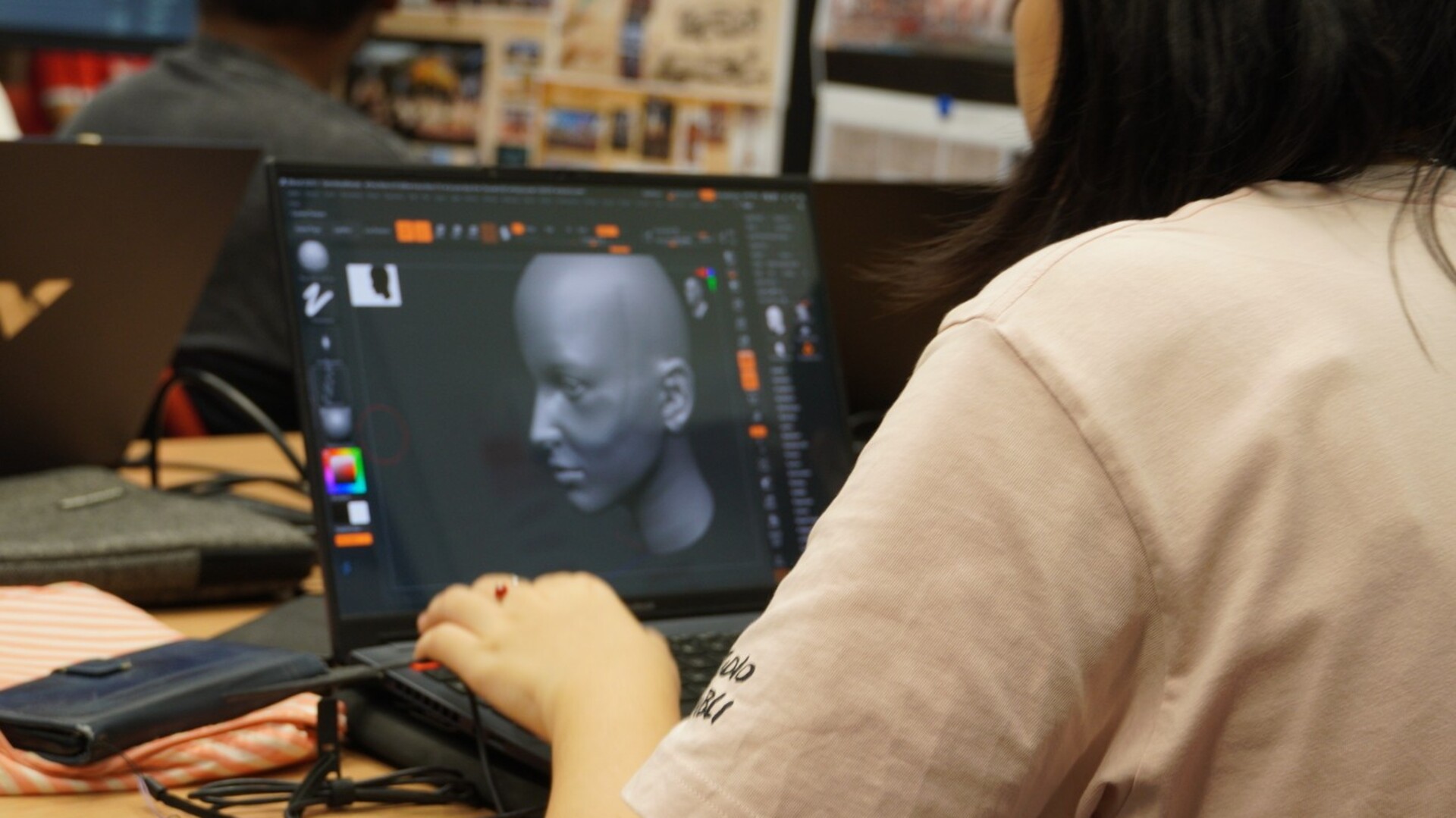
A well-built game art curriculum typically covers 3D modeling, digital sculpting, texturing, and rendering, as well as concept art fundamentals such as character and environment design.
Crucially, this shouldn’t be taught in isolation from actual production pipelines. Strong programs run in a studio-simulated environment, meaning students work through the same asset creation process professionals use: pre-production, iteration, feedback, and final integration into a game engine.
The capstone stage matters most. This is usually where students take everything they’ve learned and apply it to a cohesive project, whether that’s a set of game-ready character and environment assets or a full concept art portfolio.
A graduate who walks away with a polished capstone project has something far more useful in job interviews than a transcript.
What Creative Careers in Singapore Actually Pay
Compensation data for creative technology roles varies by source, so it’s worth looking at multiple sources.
| Role | Entry-level (approx.) | Senior-level (approx.) | Source |
| Game Artist | S$64,183/year | S$103,453/year | ERI SalaryExpert |
| Game Artist | S$39,864/year (25th pct) | S$58,740/year (90th pct) | Glassdoor SG |
| 3D Game Artist | ~S$45,800/year | ~S$50,000/year | Glassdoor SG |
| Game Designer | ~S$40,900/year (25th pct) | ~S$80,400/year (90th pct) | Glassdoor SG |
| Game Developer | ~S$40,000/year (25th pct) | ~S$79,000/year (90th pct) | Glassdoor SG |
PS: ERI Salary Expert draws on broader compensation surveys, while Glassdoor’s figures for niche roles like game art in Singapore are based on smaller, self-reported samples (sometimes fewer than 30 data points), which naturally produce a wider, sometimes lower, range.
The pattern worth taking away isn’t the exact number; it’s the trajectory. Entry-level compensation in game art and adjacent creative technology roles roughly doubles by the time someone reaches the senior level, and portfolio quality tends to be the biggest lever an individual has for how quickly they move along that curve.
Comparing Program Types: Diploma, Advanced Diploma, or Degree Top-Up?
| Program Type | Typical Duration | Best For | What It Leads To |
| Diploma | 9 to 12 months | Building foundational skills and a first portfolio | Entry-level roles or progression to an advanced diploma |
| Advanced Diploma | 9 to 11 months | Students who already have foundational training | Specialised, production-ready skill sets and stronger portfolios |
| Degree Top-Up | Typically 1 year (Stage 3 direct entry) | Diploma holders who want a full degree without repeating years of study | A recognised bachelor’s degree, often through an overseas university partnership |
The right choice depends mostly on where you’re starting from. Fresh graduates with no prior creative training often begin with a diploma. Career switchers with some design or art background may be able to enter at the advanced diploma or even direct-entry degree level.
Where MAGES Fits
MAGES Institute of Excellence is one example of a Singapore creative technology school built around the criteria above.
It’s been running since 2010, holds EduTrust certification as a registered PEI, and was recognised among the Top 50 Creative Schools Worldwide and Top 10 Globally for Concept Art by The Rookies in 2025.
Our programs, including diplomas in Game Art, Concept Art & Entertainment Design, and an Advanced Diploma in Game Art, are structured around studio-simulated, project-based learning rather than lecture-heavy instruction.
As an Unreal Engine Academic Partner, MAGES also gives students access to current industry-standard tools rather than dated software.
Faculty backgrounds include mentors who’ve worked at Weta Workshop, Lucasfilm, Industrial Light & Magic, and SEGA, which speaks directly to the “industry mentorship” criterion outlined earlier in this guide.
Conclusion: Choosing What’s Right for You
There’s no single “best” creative media school in Singapore, only the one that fits where you’re starting from and where you want to end up. Before comparing institutions, it helps to clarify the discipline you want to work in, since that decision shapes almost everything else, from curriculum to career outcomes.
From there, the five criteria in this guide- mentorship, curriculum structure, tool currency, accreditation, and graduate outcomes- give you a concrete way to compare options rather than relying on marketing copy alone.
Frequently Asked Questions
Is a private creative media school worth it in Singapore?
It depends on what you’re optimizing for. Private institutes tend to offer faster, more specialized, project-based training aimed at a specific creative technology field, which can suit students who already know they want to work in, say, game art or concept art. Students who want a broader general education might be better served by a polytechnic or university first.
What’s the difference between a game art diploma and a game design diploma?
Game art focuses on visual production, including 3D modelling, sculpting, texturing, and concept art. Game design focuses on systems, mechanics, and gameplay, typically taught through engines like Unity and Unreal Engine. Some careers benefit from exposure to both, but the day-to-day skill sets are distinct.
Can I get a recognised degree through a private creative media school in Singapore?
Some private institutes have direct partnerships with overseas universities that allow diploma or advanced diploma graduates to enter the later stages of a bachelor’s degree, without repeating earlier years of study. It’s worth confirming which specific university a school partners with and at what stage of entry it offers admission.
How much can I expect to earn as a game artist in Singapore?
Estimates vary by source, but entry-level game artists in Singapore can expect somewhere in the range of S$40,000 to S$64,000 a year, with senior-level artists earning upward of S$100,000 depending on studio and specialisation.
Related Posts
SPEAK TO AN ADVISOR
Need guidance or course recommendations? Let us help!
